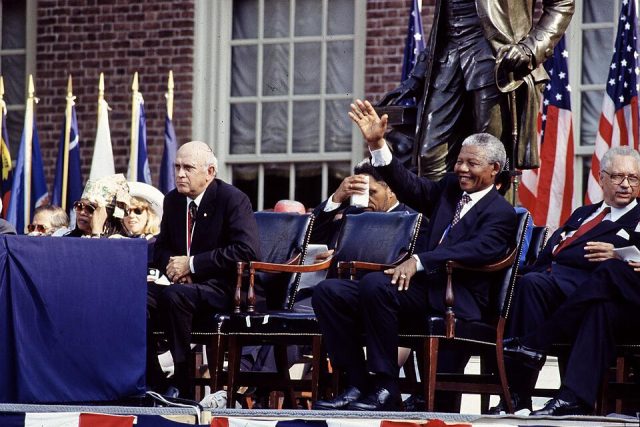

In June 1991, South Africa took another major step towards dismantling apartheid when Parliament approved the repeal of several laws that had enforced racial classification, residential segregation and restrictions on land ownership. The changes included the Population Registration Act of 1950, the Group Areas Act and legislation governing racially restricted land ownership.
The changes took place under State President FW de Klerk, whose government had begun dismantling parts of the apartheid legal system following the unbanning of liberation organisations in February 1990.
The repeal of these laws removed important legal foundations of racial segregation. However, it did not immediately end apartheid or give all South Africans equal political rights. The country still had to negotiate a new constitutional and democratic system.
Key facts
- Year: 1991.
- Main dates: 17 June, 28 June and 30 June 1991.
- Country: South Africa.
- State President: FW de Klerk.
- Main legislation: Population Registration Act Repeal Act 114 of 1991 and Abolition of Racially Based Land Measures Act 108 of 1991.
- Laws affected: Population Registration Act, Group Areas Act, 1913 Natives Land Act and 1936 Native Trust and Land Act.
- Outcome: Major legal restrictions based on race in population classification, residential areas and land ownership were repealed.
- Political significance: The changes formed part of the wider negotiations and political transition towards democratic government.
Which apartheid laws were repealed in 1991?
Several laws had been used to organise South African society according to racial categories. They controlled where people could live, what land they could own and how the government officially classified them.
Three particularly important examples were the Population Registration Act, the Group Areas Act and the land legislation introduced in 1913 and 1936.
Population Registration Act of 1950
The Population Registration Act, Act 30 of 1950, required South Africans to be classified according to race.
People were registered as belonging to racial categories including White, Black, Coloured and Indian. These classifications became central to the administration of apartheid because other laws used a person’s assigned racial category to determine their rights and restrictions.
The system affected where people could live, work and access different facilities.
On 17 June 1991, Parliament voted to repeal the Population Registration Act. The Population Registration Act Repeal Act 114 of 1991 formally repealed the legislation and came into operation on 28 June 1991.
However, the population register compiled under the 1986 Identification Act was retained until the repeal of the 1983 Constitution, according to the Truth and Reconciliation Commission’s historical record.
Group Areas Act
The Group Areas Act controlled where different racial groups could live and own property.
The legislation created racially designated residential areas. People could be forced to leave neighbourhoods that had been assigned to another racial group, while property ownership and occupation were restricted according to racial classification.
The law contributed to forced removals in communities across South Africa, including areas such as District Six in Cape Town and Sophiatown in Johannesburg.
The original Group Areas Act was introduced in 1950. It was subsequently replaced by the Group Areas Act of 1957 and then the 1966 legislation.
The 1966 Group Areas Act was repealed through the Abolition of Racially Based Land Measures Act 108 of 1991, which came into operation on 30 June 1991.
The 1913 and 1936 Land Acts
Land legislation was another central part of racial segregation in South Africa.
The Natives Land Act of 1913 restricted where black South Africans could buy or occupy land. It limited African land ownership to approximately 7% of the country’s land area.
The Native Trust and Land Act of 1936 increased the designated land allocation to approximately 13%.
These laws contributed to the dispossession of black communities and the establishment of areas designated for African occupation. They also formed part of the legal framework that supported the development of the apartheid homeland system.
Both laws were repealed through the Abolition of Racially Based Land Measures Act 108 of 1991.
How were the apartheid laws repealed?
The repeal of the legislation took place during the political changes that followed the government’s decision to unban the ANC and other political organisations in February 1990.
FW de Klerk’s government had announced plans to dismantle several apartheid laws as part of its reform programme.
1990: Plans to remove segregation legislation
On 19 April 1990, De Klerk announced in Parliament that the Group Areas Act would be replaced by new, non-discriminatory measures.
The announcement formed part of wider plans to remove legislation that enforced racial separation in South African society.
However, the proposed changes still had to pass through Parliament before the existing laws could be formally repealed.
5 June 1991: Land legislation adopted
On 5 June 1991, Parliament adopted the Abolition of Racially Based Land Measures Act 108 of 1991.
The legislation provided for the removal of restrictions based on race or membership of a particular population group in the acquisition and use of land.
It also provided for the phasing out of certain racially based institutions and statutory systems.
The legislation covered the repeal of the 1913 Natives Land Act, the 1936 Native Trust and Land Act, the 1966 Group Areas Act and the 1984 Black Communities Development Act.
17 June 1991: Population Registration Act repeal
On 17 June 1991, Parliament voted to repeal the Population Registration Act of 1950.
The decision removed the legal foundation of the compulsory racial registration system that had been used to classify South Africans under apartheid.
The formal repeal took effect on 28 June 1991 through the Population Registration Act Repeal Act 114 of 1991.
28 and 30 June 1991: Land and residential restrictions removed
The Abolition of Racially Based Land Measures Act was promulgated on 28 June 1991 and came into operation on 30 June 1991, subject to specific exceptions and different commencement dates for certain provisions.
Its implementation repealed the major land and residential segregation legislation covered by the Act.
The two legislative changes in June 1991 therefore addressed different parts of the apartheid system: racial classification and restrictions on land and residential occupation.
What did the repeal of apartheid laws mean for South Africans?
The removal of these laws meant that important legal restrictions based explicitly on racial classification and land ownership were being dismantled.
The repeal of the Population Registration Act ended the compulsory racial classification system established under that legislation.
The removal of the Group Areas Act ended the legal framework used to designate residential areas according to race. The repeal of the Land Acts also removed major statutory restrictions that had limited black South Africans’ access to land.
However, the repeal of these laws did not reverse the consequences of decades of segregation and forced removals.
Communities that had lost homes and land did not automatically receive their properties back. The country’s unequal distribution of land and housing also remained an issue requiring further government action.
The Abolition of Racially Based Land Measures Act established provisions for changes to land administration, but it did not immediately resolve the country’s land ownership inequalities.
South Africa also remained without universal democratic voting rights in 1991. Negotiations over a new political settlement and constitution were still required.
What happened next?
The repeal of major apartheid laws formed part of a wider political transition that continued over the following years.
- 2 February 1990: FW de Klerk announces that the ANC, PAC, SACP and other organisations will be unbanned.
- 11 February 1990: Nelson Mandela is released from Victor Verster Prison after 27 years.
- 19 April 1990: De Klerk announces plans to replace the Group Areas Act with non-discriminatory legislation.
- 5 June 1991: Parliament adopts the Abolition of Racially Based Land Measures Act.
- 17 June 1991: Parliament votes to repeal the Population Registration Act.
- 28 June 1991: The Population Registration Act Repeal Act comes into operation.
- 30 June 1991: The Abolition of Racially Based Land Measures Act comes into operation.
- 20–21 December 1991: The Convention for a Democratic South Africa (CODESA) begins its first plenary session, bringing political parties and other representatives together to discuss the country’s constitutional future.
- 27 April 1994: South Africa holds its first democratic general election based on universal adult suffrage.
- 10 May 1994: Nelson Mandela is inaugurated as President of South Africa.
Why it matters
The 1991 repeal of major apartheid laws removed important legal mechanisms used to classify South Africans by race and restrict where black people could live and own land. These changes formed part of the political and legislative transition that eventually led to South Africa’s first democratic election in April 1994.
Frequently asked questions
Which apartheid laws were repealed in 1991?
Important examples included the Population Registration Act of 1950, the Group Areas Act of 1966, the Natives Land Act of 1913 and the Native Trust and Land Act of 1936.
When was the Population Registration Act repealed?
Parliament voted to repeal it on 17 June 1991. The Population Registration Act Repeal Act 114 of 1991 came into operation on 28 June 1991.
When was the Group Areas Act repealed?
The 1966 Group Areas Act was repealed through the Abolition of Racially Based Land Measures Act 108 of 1991, which came into operation on 30 June 1991.
What was the purpose of the Population Registration Act?
The Population Registration Act required South Africans to be classified and registered according to racial categories. These classifications were used to administer various apartheid laws.
What did the 1913 Land Act do?
The Natives Land Act of 1913 restricted black South Africans from buying or occupying land outside designated areas. It initially limited African land ownership to approximately 7% of South Africa’s land.
Did the repeal of apartheid laws end apartheid in 1991?
No. The repeal removed important parts of the legal framework supporting racial segregation, but apartheid and political inequality had not completely ended. Negotiations towards a democratic constitution and universal voting rights continued.
Who was president when the apartheid laws were repealed?
FW de Klerk was State President during the 1991 legislative changes. His government introduced reforms that formed part of the transition away from apartheid.
Sources and further reading
- South African History Online – South African Parliament Votes to Repeal the Legal Framework of Apartheid: https://sahistory.org.za/dated-event/south-african-parliament-votes-repeal-legal-framework-apartheid
- South African Government – Abolition of Racially Based Land Measures Act 108 of 1991: https://www.gov.za/documents/abolition-racially-based-land-measures-act
- South African Government – Land Reform: https://www.gov.za/issues/land-reform
- South African History Online – The Population Registration Act of 1950 Is Repealed: https://sahistory.org.za/dated-event/population-registration-act-1950-repealed
- Truth and Reconciliation Commission – Final Report, Volume 1, Chapter 13: Apartheid Legislation: https://www.justice.gov.za/trc/report/finalreport/volume%201.pdf
- The O’Malley Archives – 1991 Chronology: https://omalley.nelsonmandela.org/index.php/site/q/03lv02039/04lv02040/05lv02042.htm
- South African History Online – List of Laws on Land Dispossession and Segregation: https://sahistory.org.za/article/list-laws-land-dispossession-and-segregation
UNCERTAIN OR UNCONFIRMED
- The exact date of repeal: Some historical timelines identify 17 June 1991 as the date Parliament voted to repeal the Population Registration Act. The formal repeal took effect on 28 June 1991. These are different stages of the legislative process, not necessarily conflicting dates.
- The Group Areas Act date: The 1966 Act was repealed under the Abolition of Racially Based Land Measures Act, which commenced on 30 June 1991. Earlier versions of the Group Areas Act had already been replaced by subsequent legislation.
- The immediate impact on land ownership: The repeal removed legal restrictions but did not automatically return land to communities dispossessed under earlier legislation. The subsequent land reform process addressed separate issues of restitution and redistribution.